Tuesday, June 6, 2023

Once the Toothpaste is Out of the Tube


Because of the Pandemic, many workers, the white collar workers that could, were forced to work from home.  It was a shock at first to be certain.  There were issues with parents who had to work and also had to manage their children and their remote chaos.  Slowly, chaos of the first days subsided, the children returned to in-person school, and workers invested in better and more comfortable home offices.  People got over the “zoom fatique,” appreciated not having to commute, and began to enjoy the new normal of working from home. 

As we have declared the Pandemic over, the workers that got used to working from home actually prefer to work from home.  As some corporate leaders are trying to get people back into the office, they are finding push back from their employees.  People have adjusted their lives and lifestyles around remote working.  We all know people who have moved to more scenic, rural, or lower cost of living locales because they can and still effectively do their jobs.

I remember in the last days of my corporate life in 2007 when I would be in our division president’s office with the VP of HR and our CFO for a morning meeting.  Now and then, we would look out his window over the parking lot and they would all comment on who was coming in at 8:30, 9:00, or even 9:30.  They thought people were slacking off if they weren’t at their desks right at 8.  They were adamantly against anyone working from home.  I once raised the notion, “Wouldn’t it be OK to work from home now and then if the work still got done?”  The reaction from the rest of the leadership team was short, adamant, and a most resounding “NO!”  I never brought it up again.

It wasn’t only the company I was working at then, it was true of everyplace I ever worked.  Management wanted people in the office, at their desks, under their watchful eyes, and at their beck and call.  This made a lot of sense in the days before everyone had a laptop.  It progressively made less sense with the popularity of the internet, remote access via the cloud to the everything anyone needed to do their job, and texting/video meeting platforms.  Remote working has been possible for at least ten years, but management was not.  The Pandemic changed all that.

Now management is having a tough time reversing the trend.  Part of this is due to the employment market.  Workers can push back on management because there is still low unemployment.  They can and will find other employment if they need or choose to.  Management will have more leverage If and when unemployment increases.

There are advantages to working in an office with everyone.  The advantages are beyond just getting the job done.   There is the comradery and informal team building from people just being together all day.  It is the informal conversations, having lunch or coffee, or hanging out after work.  Trust and alliances facilitated by such interactions.  Even when socializing, work is still somehow discussed.  Younger folk that only know remote work may be missing out on this important aspect of work life.

Basically, I see a mix of work; a split between the office and working remotely.  It would be the best of both worlds.  It is not easy to put the toothpaste back in the tube. 

Sunday, June 4, 2023

Adlai E. Stevenson II


In his study to the Historic Home

I graduated in June of 1971 from the Adlai E. Stevenson High School in Livonia, Michigan. 

I was aware the Adlai Stevenson (1900-1965) had served as a US Senator from Illinois, ran for President twice against Eisenhower, and served as the US Ambassador to the United Nations. 

When we moved to Illinois in 2007, we settled in Lake Forest.  In driving around, I noticed the Adlai E. Stevenson Historic Home on St. Mary’s Road a mere 3.6 miles from our house.  I made a mental note that I ought to visit the house, given that my high school was named for him.  But there were no hours on the signage and place never looked open.  Sure, I could have searched online, but honestly my interest level was little more than a passing fancy.  At that point, I was mostly thinking of Stevenson as the poor fellow who the Democrats selected twice to run against the Dwight D. Eisenhower, the hero of World War II.

We signed up for the newsletter of the Lake County Forest Preserves.  As it turns out, the Adlai E. Stevenson Historic Home is owned and run by the Forest Preserves.  The first email newsletter offered a few dates to visit the home and we took advantage of the opportunity. 

I learned a lot about Stevenson today.  I learned his family has long been involved in politics.  His maternal great-grandfather, Jesse W. Fell, was a friend of Abraham Lincoln and his campaign manager.  His grandfather, Adlai Stevenson I, served as Vice-President of the United States from 1893-1897 under Grover Cleveland.  Before being elected to the Senate, Stevenson served as Governor of Illinois from 1949-1953.

Stevenson had three sons Adlai III, John, and Borden.  Adlai III served as Senator from Illinois from 1970-1981.  The actor MacLean Stevenson, known for his role as Colonel Henry Blake on the MASH TV series, was a second cousin.

I also wondered why our high school was named for an Illinois politician and not a notable Michigander?  As it turns out, Adlai E. Stevenson II died suddenly of a heart attack in London on July 14, 1965.  On July 15th, the Livonia School Board met and naming the new high school was on the agenda.  As Stevenson was highly regarded in the 1950s and 60s, the school board decided to name thyeir new high school after Stevenson.  Ours was the first high school in the nation named for Stevenson.  I am guessing it was also the first school at any level named for him.  On October 24th of that year, Vice-President Hubert Humphrey attended the dedication and delivered an address in honor of his friend and colleague Adlai Stevenson.  The first graduating class of Adai Stevenson High School was in 1968.  Mine, in 1971, was the fourth.

I am prouder than ever to be a graduate of Adlai E. Stevenson High School.

In thinking about my view of Stevenson before visiting the house most naïve and foolish of me.  He was known for his speeches that touched the heart of issues.  And whether folks agreed with his views or not, he was always respected.  We need more Adlai Stevensons today.   I will read more on Stevenson.  

I was impressed bythe few quotes I read on the tour.  Here are a few examples all from :azquotes.com.

  • Public confidence in the integrity of the Government is indispensable to faith in democracy; and when we lose faith in the system, we have lost faith in everything we fight and spend for.
  • A hypocrite is the kind of politician who would cut down a redwood tree, then mount the stump and make a speech for conservation.
  • The human race has improved everything, but the human race.
  • To act coolly, intelligently and prudently in perilous circumstances is the test of a man - and also a nation.

Here is what others have said about Stevenson (all from Wikipedia):

  • Stevenson's gift to the nation was his language, elegant and well-crafted, thoughtful and calming.
    ~ David Halberstam, The Fifties.
  • If the Electoral College ever gives an honorary degree, it should go to Adlai Stevenson.
    ~ W. Willard Wirtz, friend and law partner.
  • In regard to his two runs for President, “…what would be remembered...were not his public programs and ideas for a New America but, ironically, the private man – his character and personality, his wit and charm, his efforts to negotiate and keep the peace within the Democratic Party, his elegant speeches, and the grace with which he accepted defeat.”
    ~ Jean A. Baker, The Stevensons:  A Biography of An American Family.

===


Stevenson's Study


Wednesday, May 31, 2023

Chidem Inch: May 28th


This week, we marked May 28—the 105th anniversary of the establishment of the first Armenian Republic. It was the first Armenian ruled nation in 600 years. Given the devastation of the 1915 Genocide, it is remarkable that this country was even born. For once in our recent history of tragic luck, the alignment of the planets and stars was with us. The Russians were occupied with the Bolshevik revolution some seven months earlier. Turkey was in the last days of what was left of the Ottoman Empire and the end of World War I.

The Armenians faced the Turks for a battle for the future of the nation. Would the Turks deliver the final blow or would the Armenians be able to persevere? It came down to three battles from May 22-29, 1918. The battles were in Bash Abaran, Karakilise and Sardarabad. The ultimate battle, not to diminish the value of the other two, was Sardarabad. It was indeed the battle for survival. Armenian forces and citizens (armed with whatever they had) formed a fierce band and fought hard for the survival of the nation.

In his 1990 book Armenia: Survival of a Nation, historian Christopher Walker noted that if the Armenians lost the Battle of Sardarabad, “it is perfectly possible that the word Armenia would have henceforth denoted only an antique geographical term.”

The First Republic was improbable in both inception and being successful. After the horrors and tragedies of 1915, it was amazing that we even had a Republic. Those intrepid souls who established the Republic were burdened with a destitute land and people. It lasted two years until the Soviets and Armenian Bolsheviks made the Republic part of the Union of Soviet Socialist Republics. There were plusses and minuses to being an SSR. The minuses were the loss of Nakhichevan and Artsakh to Azerbaijan. The major plus was that Armenia survived and thrived until 1991 when the current Republic of Armenia was established with the fall of the Soviet Union.

Without those three battles and the efforts of the brave Armenians who fought them, there would be no Armenia today. It was a pure existential time for the Armenians. We need to acknowledge, honor and celebrate those times, those victories and that first Republic.

We have to also acknowledge that our plight is still existential. This has been brought to the forefront by the 2022 war in Artsakh and the negotiations/threats by Turkey and Azerbaijan since then. It seems a Sardarabad-like victory with the rallying of all citizens armed with guns will not work against the well-armed Azeri/Turkish forces we faced in 2022. We, all Armenians, need to look to the future of the nation, where we are now and what we can do moving forward.

In the Diaspora, we also have to come to terms with our role in this. We are Armenians, but we are not citizens of the Republic of Armenia. We can support, advocate, influence, certainly provide funds, and even be strategists and thought leaders. But our roles are, de facto, secondary no matter how we view ourselves and the resolve with which we state we disagree or are upset by this or that. We have no seat at the negotiation table.

Of course, being a Diasporan Armenian, I think we should. But the world is not structured or wired that way unless we can somehow garner the needed influence. How might that be accomplished? Well, that is the big question. Money and power are the typical answers. Someone close to me reacted to one of my articles by saying, “But, you offered no solutions.”  That is absolutely true. I am stymied by the current Armenian predicament. It is a source of great angst and frustration. Yet, I see no one offering any solutions for the guaranteed safety and security of Armenia and Armenians in Artsakh. We have hope. We have righteousness. The only solutions that might work seem to require compromises that are so unacceptable to us, that no one but Pashinyan has uttered one.

We have to reach back and acknowledge the importance of those three victories in May of 1918. We need that unifying spirit inside each and every one of us. We also need a chance to keep our Republic and build it into an economic force that is capable of defending itself. That is my May 28th wish and vision. It is a grand vision and a huge challenge.

Getseh Hayastan yev Hayeruh.

===

Oringinally Pulished in The Armenian Weekly


Monday, May 29, 2023

Two 1950’s TV Shows


I remember, vaguely, when we got our first television.  Maybe I was 4, 5, or 6 years old and thus 1957, 1958, or 1959.  I cannot even remember my Dad bringing it home or setting up.  I don’t remember the brand.

What I do remember is that we lived on Freeland in the city of Detroit.  That first TV was black and white.  It had a pretty small screen maybe 13” like the laptop I am writing this piece on.  What I remember most about that TV is that the length of the TV, from front to rear, being at least twice the height or width of the front of the set.

Of course, I remember the children shows of the era:  Romper Room, Captain Kangaroo, Mighty Mouse, The Mickey Mouse Club, and local shows that included Captain Jolly and Soupy Sales.

There were also series that I watched that included The Lone Ranger, Roy Rogers, and Superman that were on early enough for someone that went to bed at 7 pm to watch. I am not sure when The Three Stooges entered the picture, or rather the TV,  but they were certainly a game changer.

There are two shows, more obscure than those listed that I really enjoyed watching:  Sky King and You Asked For It.  I am not sure how popular those shows were back then, but I really liked them.  I imagine they weren’t really popular as I have never really seen either syndicated.  For some reason, these two shows popped into my head the other day.  I decided to search for them on Comcast.  There were four episodes of Sky King and one of You Asked For It on Hulu.  I watched on of each.


Sky King (1952-59) was a centered around Schuyler "Sky" King, a daring aviator played by Kirby Grant, who protects the innocent and fights crime from the skies. Together with his niece Penny and their Collie Clipper, Sky got into a crime fighting adventure in each episode.  Sky helped solve each crime using his flying skills in his trusty Cessna named Songbird.  The lived and solved crimes in, I am guessing, California.  I was enamored with his flying skills and the aerial camerawork.  I wanted to learn to fly and own my own plane someday.

You Asked For It (1950-59) was a TV show that captivated me and introduced a world of curiosity and wonder. Each episode involved requests from viewers ranging from extraordinary feats, super cool inventions, to mind-bending experiments. The host, Art Baker, was captivating and a natural storyteller.  With the assistance of team of experts, the show took on the challenge to fulfill these unique requests, delivering demonstrations and uncovering secrets that fascinated me. You Asked For was entertaining and, for me, very educational.  I was always amazed and satisfied.  The show impressed with ingenuity of people and the power of the human spirit.  I remember seeing cars that drove into the water and became boats, personal helicopters, jugglers, acrobats, sharpshooters, and so much more.

These two TV shows really came to life on our first little TV.  It was a great saunter down Nostalgia Lane.

Friday, May 26, 2023

Bakhmut


rferl.org

In January of 2022, a month before the Russian invasion of Ukraine began, the population of Bakhmut was 71,000.  In the early days of the war, Bakhmut was considered to be a key city to the Russians.  By taking Bakhmut in the Donetsk Oblast (province, they believed they would disrupt Ukrainian supply routes.  The Russians believed this would give them the upper hand to take the entire province. 

The Russian offensive stalled due to a fierce Ukrainian defense of the Bakhmut.  The Russian relentlessly pounded the city with rockets and artillery.  50,000 of the population moved out by May of 2022. By December 2022, only 4,000 people remained in the city which had been bombed into ruins.  Still the Ukrainians defended the city.  The Russians were equally driven to take the city to turn the tide of their failing invasion.  Finally, on May 24, the Russians took finally took the city or the wasteland that once was Bakhmut.  

Actually, it was not the Russian Army but their mercenaries known as the Wagner Group.  It is the private army of Yevgeny Prigozhin and presumeabley.  Prigozhin was a competitive cross-country skier who became a thief and served jail time in the waning days of the Soviet Union.  Upon release from prison he became a hot dog seller in a flea market in Leningrad, he quickly grew his enterprise becoming an oligarch of gambling, restaurants, and supermarkets in the post-Soviet era. 

In the 2000s, Prigozhin became a confidant of Vladimir Putin landed large government contracts for food services.  His government service extended to the Wagner Group, which he claimed to have founded to support the Russian miliary incursion into Donbas in 2014.  The mercenary group was used as an extension of the Russian military in a variety of operations including Syria in 2018.  With the stalling and failure of the Russian military in the Ukraine invasion, the Wagner Group has taken a larger war.  Prigozhin has criticized the leadership of the Russian forces creating a rift with the Russian generals.  Where Russian troops have failed with reluctant recruits, Prigozhin claimed he could succeed with his troops which included something like 50,000 released prisoners.

The Wagner Group took Bakhmut and are turning over operations there to the Russian army.  But they did so at a large cost.  Prigozhin has admitted to losing 20,000 troops in the taking of Bakhmut.  Half of those were released prisoners.  There were no estimates of how many Ukrainian soldiers were killed.

20,000 mercenaries killed to take one town.

This is a staggering number.  I am sure Prigozhin quoted it to motivate the Russian’s and drive fear into the Ukrainians that his Wagner Group will never give up. 

I look at it as a sad testimony to the horrors of war and men, dictators like Putin, who start them.  The entire population of Bakhmut were forced from the home and lives they were living.  20,000 Russians and who knows how many Ukrainians lost their lives for what, the glories of Putin and Prigozhin?  Do either need more money or power?  Of course not.  What is in their hearts?  How do they live with themselves being responsible for the loss of so many lives? 

I have no answers but that this is the way of the mankind and has been through the ages.  No matter how modern we think we are, warlords will rise to power and use people like pawns.

Wednesday, May 24, 2023

Chidem Inch: Caving In


southfront.org

Will May 22, 2023 go down as a black day in Armenian history?

It certainly feels like that right now.

This was the day Armenian Prime Minister Nikol Pashinyan stated, “The 86,600 square kilometers of Azerbaijan’s territory includes Nagorno-Karabakh.” Even though we all knew this was the way the Republic of Armenia was leaning, it is still shocking, depressing and maddening to hear this. Of course, there was also a stated condition that the rights of the Armenians in Artsakh be guaranteed.

There were pro-Artsakh protests in Armenia the day before this anticipated announcement. Today, in the diaspora, there was indignation on social media. Aram Suren Hamparian basically summed up in one sentence what most of us are feeling: “Pashinyan lacks the legal right, popular mandate, moral standing, and constitutional authority to sign away the free people of democratic Artsakh to certain genocide at the hands of authoritarian Azerbaijan.”

People were, again, calling Pashinyan a traitor.

Sadly, Armenia and the Armenians have had little negotiation leverage since the horrible 2020 war. Neither Artsakh nor Armenia have a military option. There is no military ally for the Armenians. There is nothing Armenia nor Artsakh could do to break the 160+ day Azeri blockade of Artsakh. We only have diplomacy. I am not sure the Armenians had much choice but to cave in, which we have.

The rest of the world recognizes the territorial integrity (it hurts to type those words) of Azerbaijan that includes Artsakh. To us, it makes zero sense that the rest of the world still honors the lines Stalin drew that gave Nakhichevan and Artsakh to Azerbaijan. It is even more mind boggling that anyone with any authority in this “negotiation” believes that the rights of the Armenians in Artsakh can be guaranteed if they are part of Azerbaijan. 

As for Pashinyan, does he have any authority? Well, he is the Prime Minister of the Republic of Armenia. Like it or not, whether he is inept or not, he is the head of the Armenian government. To the world and the countries involved in the negotiations, he speaks for Armenia and the Armenians. For all the brilliant scholars, activists and clerics in the Diaspora, not one of us was invited to the negotiating tables. Like it or not, this is the way the world works no matter how infuriating it is to us.

There is a Facebook group: “Armenian Prime Minister Nikol Pashinyan for Nobel Peace Prize.” It has a whopping 92 members.

We could speculate on how another Prime Minister would have fared. Would Serge Sargsyan or Robert Kocharyan have done any better? None of them prepared us for the inevitable second Artsakh war.

How will this all turn out? No one really knows. Will the negotiations result in a signed treaty? If there is a signed treaty, will the parties honor the provisions of the treaty? It is hard for me, and I imagine anyone reading this, to put a positive spin on any of this.

===

Originally published in the Armenian Weekly 

Tuesday, May 23, 2023

Razor-Razorblade Model on Steroids


There is a business model called the Razor-Razorblade model.  Basically, the razor handle is sold at cost or even a loss and the producer makes their money on selling razor blades on a recurring basis.  The same model applies to printers and ink cartridges.  The printers sell for a nominal charge, probably close to cost, and the manufacturer makes their money on the continual sale of ink cartridges for the life of the machine.  Cloud based storage like Google Drive and Dropbox actually give a base level of storage for free and then charge annually for more storage as the user uses the free storage up and gets dependent on the platform.

Investopedia defines the model more precisely:


The razor-razorblade model is a pricing tactic in which a dependent good is sold at a loss (or at cost) and a paired consumable good generates the profits.

Also known as a razor and blades business model, the pricing and marketing strategy is designed to generate reliable, recurring income by locking a consumer onto a platform or proprietary tool for a long period. It is often employed with consumable goods, such as razors and their proprietary blades.

There has been some buzz lately about the model extending to a variety of products.  There are reports that some auto manufacturers are contemplating monthly charges for things as mundane as floor mats to more sophisticated options like heated and cooled seats.  Obviously, for floor mats such a move would benefit after market sales (think Weathertech).  But, for vehicles connected to the internet, like most are, features like heated seats, entertainment options, and many other features can be turned on or off remotely.  Thus, if a consumer wants these features they have to pay.

The auto companies could generate additional monthly revenue for each new car sold or leased.  Furthermore, they would continue charging for these options in the used car market simply because the internet connectivity makes it possible to do so.

Needless to say, there are estimates the 75% of the auto consuming public thinks this is, to use the vernacular, bullshit.  I am in that 75%  and believe that 75% is low. 

One of the articles I read in Business Insider hypothesized the following:

Imagine the start of a hypothetical summer Monday, some time in the future. You remotely start your coffee machine ($5 a month for the app to schedule brewing in advance and another $25 for recurring delivery of compatible pods) while you hit your stationary bike for a quick workout ($30 a month for access to classes). When you're ready to head into the office, the smart thermostat automatically turns down the air-conditioning (a $10-a-month feature) as you use an app on your phone to remotely start your car (which costs you $20 a month). And if you want to get any of that fixed? Put away your screwdriver, because you'll have to go to the manufacturer for even a minor tune-up.

Just because it can be hypothesized doesn’t mean it will necessarily happen.  There is something called competition and Adam Smith’s Invisible Hand that come into play.  If I had to pay a monthly access fee for my coffee maker beyond buying the pods.  I would immediately cease using the Nespresso and use my Moka Pot more.  Look what happened when Gillette was charging outrageous prices for blades.  Upstart e-commerce models like Harry’s popped up with more reasonable pricing and changed the dynamics of the market.  I am sure the same would happen in markets like coffee makers and other similar products.

When it comes to cars, I believe there would be a further stratification of the marketplace.  In the high-end luxury market, I would imagine monthly fees would hardly matter to folks buying or leasing cars that cost north of $200K.  Luxury buyers thrive on exclusivity and would gladly pay for that.  On the low end of the market, I can imagine Camry’s coming with base level models with no monthly fees and maybe two more feature levels with increasing monthly fees for the options packages.  Also, what would happen to these fees when the auto market goes into recession.  I imagine they would be history or waived to make sales.

Personally, I hope these grandiose notions flop in a grandiose way. 

Time will tell.

Saturday, May 20, 2023

My First Oud


My Aunt Suzie and my mother are at my aunt’s house in Reno.  The were going through and organizing old photos.  She sent me copies of a few photos she thought I would appreciate.  Appreciate them?  That is an understatement.  I love them.

There are two photos.  The first is of my grandmother, my mother, and me opening a crate from Lebanon.  Inside the crate was an oud, our cousin, who lived in Beirut, bought, packed, and shipped.  He had visited us in Detroit a few months earlier and unbeknownst to me, my grandmother, our Grannie, gave him some money to send me an oud.

This must have been 1968-69, at the latest maybe the summer of 1970.   My grandmother, who always seemed old to me, was only in her early sixties in this photo.  I am older as I write this than she was in this photo.  To my current self, she looked pretty young in that photo.

Truth be told?  Until I got this photo, I did not remember this day.  How did I, could I, have forgotten?  Who knows?  Selective memory?  The natural passage of time? Shallowness? Other memories squeezing this one, and probably many others, to the periphery.  It doesn’t matter, thanks to my aunt and the photos she texted me, the memory is delightfully restored. 

I love that three generations of Frankians, using Grannie’s maiden name, were opening the crate.  I love it that we took the second photo with me holding the oud.  I can’t remember if the instrument was even tuned when we took the photo.  I am sure it was in short order.

The oud?


It was an ornate Arab style oud.  The front was adorned with mother of pearl inlay.  They look pretty cool, but all the inlay, as I have been told, dampens the resonance of the faceboard.  The oud was big, bigger than the Armenian and Turkish ouds I now mostly play.  But, it was my first oud and I played it often.  I slapped a DeArmand pickup on it used it for two years on my twenty gigs or so. 

Another Frankian cousin, Boghos, who was a good musician himself, sent me another oud from Haleb (Aleppo).  It was another Arab oud but, as Boghos was a musician and knew the better makers and shops in Haleb, it was a very nice instrument.  I still have this one.  I learned a few years ago that the maker of this instrument is Jamil Burghaki Qandalaft who is according to Wanees Zarour’s research “… has a reputation and may have made ouds for Farid al Atrache.” 

Tonight, I am playing in the Arab concert of the University of Chicago Middle Eastern Music Ensemble.  This concert will wrap-up the 25th Anniversary Season of the Ensemble.  We are playing music mostly from Lebanon (think Fairuz) and Egypt selected by our gifted maestro, the aforementioned Wanees Zarour.  I will be playing an oud tonight, the first one I actually bought myself.  It is a 1996 oud made the late master maker Peter Kyvelos.

I wonder what that first oud would have sounded like in tonight’s concert?


Peter Kyvelos


Wednesday, May 10, 2023

Persistence


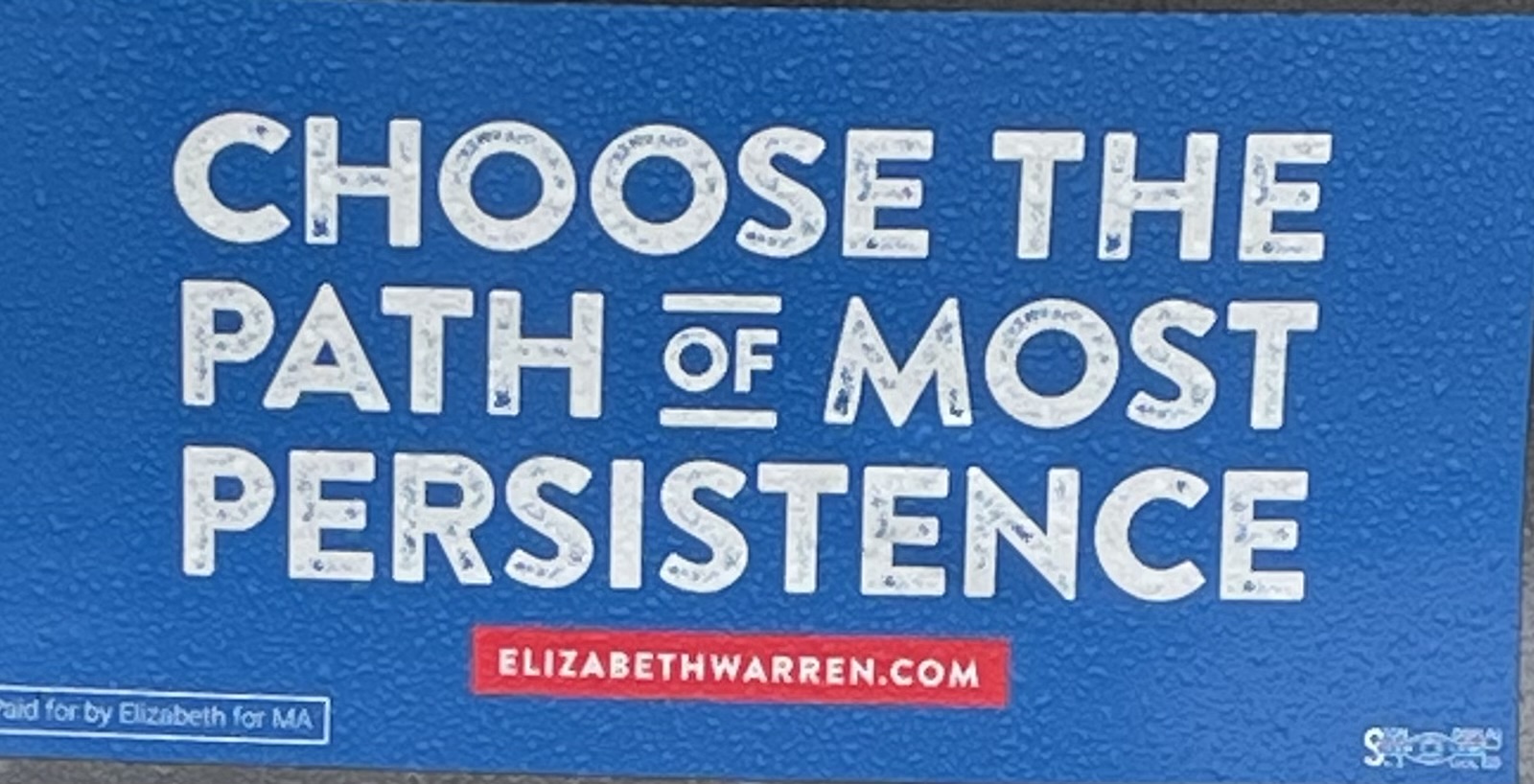
I had to run to the Post Office in our town to mail a few packages.  I parked in a municipal lot and saw a car with bumper sticker that said:


Choose the path of most persistence.


I liked it.  It was inspirational and I thought I might blog about it.  I took a photo of it to improve the probability that I would actually write about it.  Apparently, the photo worked

When I got around to looking at the photo to edit it for this blog.  I noticed that underneath the message in smaller print was a URL:  elizabethwarren.com.  On seeing this, I felt a little disappointed.  I did not want to think about this as something political.  I was thinking more about wanting to write something more akin to Never Give Up which is the most read post of this blog.  After all, persistence and never giving up are basically the same thing.

It is nothing really against Senator Warren.  About half of the time, she makes lots of sense.  She says thing and makes suggestions that make me think.  The other half of the time?  Well, the other half of the time I really think we are from different planets, and I am not sure which of us is from Earth.  I seem to disagree with her more fervor than agreeing with her makes me think hence the bit of disappointment with the bumper sticker.

Goals that take hard work and a long time to achieve require passion, dedication, and persistence.  The bigger and bolder the goal or aspiration, the more challenging it for most people, including me.  This could easily explain why I haven’t yet… well never mind.  Such disclosures would require a book to explain more than a few blogs.

This simple but powerful message of the bumper sticker reminds me of the famous quote from Calvin Coolidge:

Nothing in this world can take the place of persistence. Talent will not; nothing is more common than unsuccessful men with talent. Genius will not; unrewarded genius is almost a proverb. Education will not; the world is full of educated derelicts. Persistence and determination alone are omnipotent. The slogan 'Press On!' has solved and always will solve the problems of the human race.

I read this quote when I was an undergraduate.  I believe I saw it a poster somewhere.  Posters were with motivational or ‘make you think’ messages were quite popular back in those days.  I do not see them so much anymore.  I sometimes keep them on my phone as I suspect others do.  Of course, I have also blogged about them e.g. Motivational Quotes.

The reason the Coolidge quote resonated so well with me back in my undergraduate days is because, I was already aware that I struggle somewhat with long range goals.  I have been persistent with some goals and have had some modicum of success and satisfaction.  With others the goals?  Let’s just say they have been a bit more aspirational than successful.

I’ll keep on keeping on with what’s working and continue to try to shift the balance on the aspirational/fulfillment scale.  After all, I have Elizabeth Warren and Calvin Coolidge both urging me on.

Tuesday, April 4, 2023

For Love of the Music: The Ara Dinkjian Songbook


Earlier this month, I read the following post from Ara Dinkjian on Facebook:


Dear Friends,

Over the years, I’ve received many requests for sheet music to some of my compositions. I am proud to announce that the good folks at Aras Publishing (founded in 1993 in Istanbul by Hrant Dink, Mgrdich Margosyan and Edward Tovmasyan) have just released The Ara Dinkjian Songbook, which includes the sheet music for all of my compositions, as well as my biography written by editor Burcu Yildiz. For further information, you can email Aras Publishing at: info@arasyayincilik.com


My first thought was, “Good for Ara.” My immediate next thought was, “I have to get this book.”

I ordered it via Amazon, fulfilled by Abril Bookstore, and it arrived on March 22. I opened the box and pulled out the beautifully designed and crafted book that is in both Turkish and English. I admired the elegant cover photo of Ara holding his 1903 Manol oud. 

I first looked for my four favorite Ara Dinkjian songs that I play: “Anna Tol’ Ya,” “Homecoming,” “Offering” and “Picture.” I learned these tunes in the tradition of Armenian kef bands in the US, which is to say by ear. It was really nice to study the sheet music to see how Ara actually wrote the music versus my interpretation of them.

Ara’s Facebook announcement said the book included a biography. For some reason, I expected five, maybe 10 pages. It was a pleasant surprise to find a 74-page biography. I immediately started reading it and was even more pleasantly surprised at the content. Burcu Yildiz is the editor of this book and wrote and compiled a most excellent bio of Ara.

Yildiz is a fabulous singer having performed both with Ara, Kardes Turkuler and more. In speaking with Ara, he told me she is a scholar and professor as well. She is an expert on Gomidas and performs his songs in Armenian. I will add that she is a gifted writer who wrote the text in both languages. It is worth getting The Ara Dinkjian Songbook simply for her wonderful biography, which includes details of Ara’s musical life and insights into how he became such a gifted musician and composer. There are many quotes from Ara. We get to understand just how central music is in his life. He started by teaching himself to play his father’s oud at the age of six. We get a glimpse of the kind of top-notch professional musician he is and how he meticulously prepares for each performance and recording session and expects the same from others.

     Ara Dinkjian went into Hartt as a music education major. At first, he did not find this at all fulfilling and as Yildiz wrote:


He went to the dean’s office and said that he wanted to leave school; he dreamed of a career centered around composition or performance, not teaching. Fortunately, the dean told him that he needed to take advantage of the opportunity they had given him and asked him to come up with a proposal for a four-year oud program…In this way, he became the first student in the United States to complete an oud degree program.


The biography covers his musical performance history including his first band Night Ark, his collaborations with Sezen Aksu and Eleftheria Arvanitaki, his performances in Dikranagerd and Istanbul with his father, and his current group The Secret Trio. There are testimonials from ethnomusicologist Dr. Melissa Bilal, famed kanun player Tamer Pinerbasi, oudist Fatih Ahiskali, as well as Ara’s wife Margo and his youngest daughter Arev. Arev’s words came directly from her beautiful article “My Father’s Music Room,” published on June 28, 2020 in the Armenian Weekly.

      I am not sure if we can separate Ara’s playing from his music. His songs, to some debatable degree, are written in his unique style of playing. As Yildiz wrote:


In his own words, neither the way he sits, nor how he holds his oud, places his fingers, uses the plectrum, uses the thumb of his left hand and crosses his legs, are appropriate in the eyes of any oud teacher.


No one sits like Ara and angles the oud on his lap like he does. He uses the upstroke of the plectrum more effectively than any other oud player. He said that “he feels a certain control when playing the upstroke.” He went on to tell me that he focuses on the ring and tone of each individual note. As a result, he plays in a very measured and deliberate way that is also very fluid and flowing. He also has a unique trilling style. When he plays a taksim, any student of the music immediately recognizes that it is Ara playing based on the pacing, spacing of notes and the aforementioned techniques. To see what I am trying to convey, watch Ara play his composition “Keesher Bar.”

Don’t think for a moment that his style limits him in any way to taksims or slower, soulful pieces. Ara is very measured, deliberate, accurate and fluid with any challenging piece no matter the speed or complexity (e.g. “For Alexis,” composed by Ara).

When I first heard Fatih Ahiskali play the oud many years ago, I heard Ara’s influence in his playing. I called Ara who confirmed they were friends but, as is Ara’s nature, he took little credit. In this book, Ahiskali noted that:


Ara Dinkjian was a breaking point in my oud playing… Ara Dinkjian made me aware of getting a good tone as a priority… he is the only oudist whose heart I can truly hear in his music.


Ara classifies music into two categories: the music that we have playing in the background to whatever we are doing and the music that changes the perceptions of where you are. Ara’s compositions and recordings are definitely in the second category. My proof of this is simple. Naturally, I was listening to Ara’s recordings while writing this review. It took me six times longer to write it than normal just because my focus was drawn from typing to being engrossed in the music.

Ara played The Jerusalem Oud Festival in 2005 and 2006 from which the live albums, An Armenian in America and Peace on Earth, were recorded. Zohar Fresco, the percussionist for the performances, wrote perhaps the perfect description of Ara’s compositions:


I can’t remember when I heard Ara Dinkjian’s music for the first time; his haunting, tender melodies, sounded like they’d always been there, and I couldn’t imagine life without them.


Indeed, his compositions are haunting and tender melodies. Since they come from Ara’s heart, soul and from his very DNA, they do sound like they have always been there. They define something unique to the place where we, Armenians, came from. It is a je ne sais quoi that speaks of the land, waters and mountains and our collective ingrained memory, making them perhaps more tender and haunting to those of us scattered in the diaspora. Ara has this very view of the music he composes. He is humble, but very philosophical about it.

When it comes to Ara’s music, this phenomenon of touching the core of our beings is not unique to Armenians. It applies across many ethnicities witnessed by the recordings of his songs with added vocals from Turkey and Greece, to Israel and around the world. Musicians and listeners from all over the world value these qualities in Ara’s compositions.

Thankfully, these compositions are compiled in The Ara Dinkjian Songbook from Aras Publishing.

===

  • How does one get the book? At the time of this writing, it is a bit hard to get. I am told that will change shortly. Keep checking Amazon and social media.
  • First published in The Armenian Weekly