A former student of mine, now living and working in China, asked a simple question: “What has been the impact of the war with Iran on American college students.”
My initial reaction from the perspective of students at my school, North Park University, is about the same as the general population. Many in the US have not been pleased with the inflation of prices on just about everything because the spike in petroleum and gasoline prices due to the constrained flow of oil through the Straits of Hormuz.
Most of the humanitarian interest of the students has been focused on what Israel has done in Gaza. Iran is viewed as an extension of that situation. We have students of Middle Eastern extraction. Some are Palestinian, a larger number are Assyrian, and their concern has been with loss of life and the massive destruction of dwellings, schools, business, hospitals, and infrastructure. These same students have similar concerns for the innocent casualties in Iran.
We are a Hispanic-Serving institution with 28% of our students being Hispanic. The majority of these students have to work to afford college. The primary impact of the Israel war on the Gazans and the US war with Iran on these student, in my view, is for economic as stated above.
The
specific ways the war is affecting students across the U.S., and locally around
the Midwest, include per a summary of my reading including Google Gemini:
- Study Abroad & Travel Disruptions: Colleges have suspended travel programs and shuttered branch campuses throughout the Middle East due to airspace closures and military targets. For example, Midwestern institutions like Grinnell College in Iowa had to cancel overseas trips entirely.
- Financial Pressures: Surging global oil prices are heavily hitting students, raising the cost of basic necessities like commuting to class, groceries, and funding off-campus housing.
- Mental Health & Emotional Toll: Many students with ties to the Middle East are experiencing severe anxiety and emotional distress. Iranian-American students have reported missing sleep to track news and struggling to focus on exams while dealing with communication blackouts or fears regarding their families' safety.
- Campus Life & Activism: Student organizations and the Iranian diaspora are navigating complex internal divisions over the conflict. Many are mobilizing through on-campus meetups, support groups, and civic protests to process the crisis and advocate for the safety of civilians overseas.
There was an article in the Sunday, July 26, 2026 New York Times: Gen Z Fell Out of Love With Work. I Don’t Blame Them. This piece speaks to a malaise in Gen Z - those born between 1997 and 2012 which are exactly my students. The author, Emi Nietfeld, noted that:
Gen Z-ers are often accused of shrugging off work — in fact, they say so themselves — and who can blame them? They’ve watched millennial workers burn out, wages stagnate, degrees turn worthless and institutions crumble. Now, they’re entering what’s widely called the worst job market in years. Almost half of recent college graduates are unemployed or underemployed. The cost of living has soared; buying a house feels impossible. Who knows where we’ll live anyway once Earth is uninhabitable. One viral meme captured the prevailing sentiment that “basically nobody under 40 right now expects good things to happen ever again.”
The job market is tough these days which may be attributed to the promise/threat of reduced headcount due to AI. The wars in Gaza, Iran, and Ukraine (funny no one mentions Sudan), global warming, inflation, the political polarity in the US and maybe the world also contribute to this malaise. I can follow Emi's logic and actually see this in a few students. But, I also see youthful exuberance and determination in these students. In considering this generation, I am reminded about my own, baby boomer, generation in college. The Vietnam War, the birth of the ecology movement, civil rights, women's liberation, and gay rights had so many of us vowing never to work for "the man."
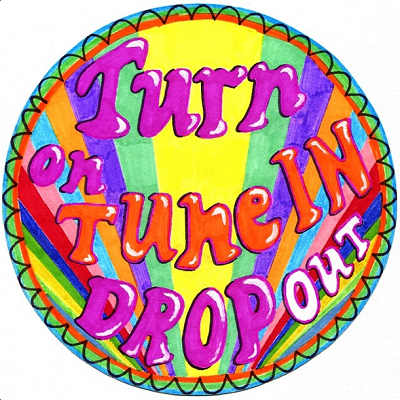
In 1966, Timothy Leary told a crowd of 30,000 hippies to "turn on, tune in, and drop out" at the Human Be-In in San Francisco's Golden Gate Park in 1967. It became one of the counterculture/hippie mantras of the 1960s.
- Turn on meant activating your neural and genetic equipment, often through media, immersion, or psychedelics, to become sensitive to the many different levels of consciousness around you.
- Tune in meant interacting harmoniously with your environment—expressing your newly discovered perspective through active engagement, art, and creation.
- Drop out didn't mean sitting on the couch doing nothing; Leary defined it as a commitment to personal autonomy. It was a call to detach yourself from rigid, conformity-driven societal structures, economic treadmills, and unexamined status quotas.
A decade later, when disco took over the music scene, it was just a hint of a mantra for far fewer of us. The rest? We graduated from college, got jobs with "the man," and over the next 20-30 years became the "the man." People, my friends, that once detested Nixon and the Vietnam War were voting for Trump and encouraging we initiate wars to turn entire regions of the Middle East into parking lots.
This is a natural progression, I have noticed. It is the job of college students to see the future as bleak while envisioning idyllic/Utopian lifestyles and vowing to never work for "the man." At the same time, people over 50 seem to always comment that "young people today are not as ambitious and hardworking as we were." Needless to say, these observations are more anecdotal than absolute.
Also times and circumstances are not exactly the same. It may be good to note the differences between generations at any point in time, but it is equally good, and perhaps wiser, to also look for how these view haven't changed over the years.

