On Friday, March 13, we ventured to Hyde Park on Chicago’s South Side to attend a concert featuring Tigran Hamasyan and Third Coast Percussion (TCP). It was the second time we had seen Hamasyan perform. The first was two years earlier, again in March, which featured intense jazz in a hip concert hall in Lincoln Park. This performance, by contrast, took place in the more traditional, 400-seat performance hall at the Reva and David Logan Center for the Performing Arts at the University of Chicago.
The audience also differed noticeably. At the earlier concert, the average age appeared to be around 30. This time, it was closer to 50. The concert quickly sold out, prompting the addition of a second performance to accommodate demand.
The first half of the program featured Chicago’s acclaimed TCP, a Grammy Award-winning percussion quartet and composer collective founded in 2005. The ensemble has become a leading force in contemporary classical music, known for its “vibrant” (The New Yorker) and “hard-grooving” (The New York Times) performances.

The opening piece, Etude No. 1, was written by Hamasyan and arranged by TCP for percussion quartet. Hamasyan joined the ensemble for the performance. The piece was light and airy, with Armenian melodic phrases as the weft to the jazz warps. The interplay of piano, vibraphone and marimba created a rich musical tapestry of point and counterpoint.
TCP continued with three additional selections, each commissioned with the support of benefactors. The first, Lady Justice / Black Justice, The Song, was composed by Jessie Montgomery and inspired by Ori G. Carino’s painting Black Justice. Montgomery described the work as “a deep collaboration and artistic symbiosis” between composer, ensemble and visual artist. “I am privileged to call them friends in music and in life,” he stated.
The next piece, Orion, by Brazilian composer and guitarist Sérgio Assad, was written in celebration of TCP’s 20th anniversary in 2024. Structured in five movements, it showcased the ensemble’s virtuosity: Sean Connors, Robert Dillon, Peter Martin and David Skidmore performing with precision and dynamic range.
The final piece of the first half, Sonata for Percussion, was composed by Hamasyan in 2024. I loved this piece. While structured in a classical sonata structure, it was done Hamasyan style, infusing Armenian motifs and melodic notions into a jazz form fluidly and seamlessly.
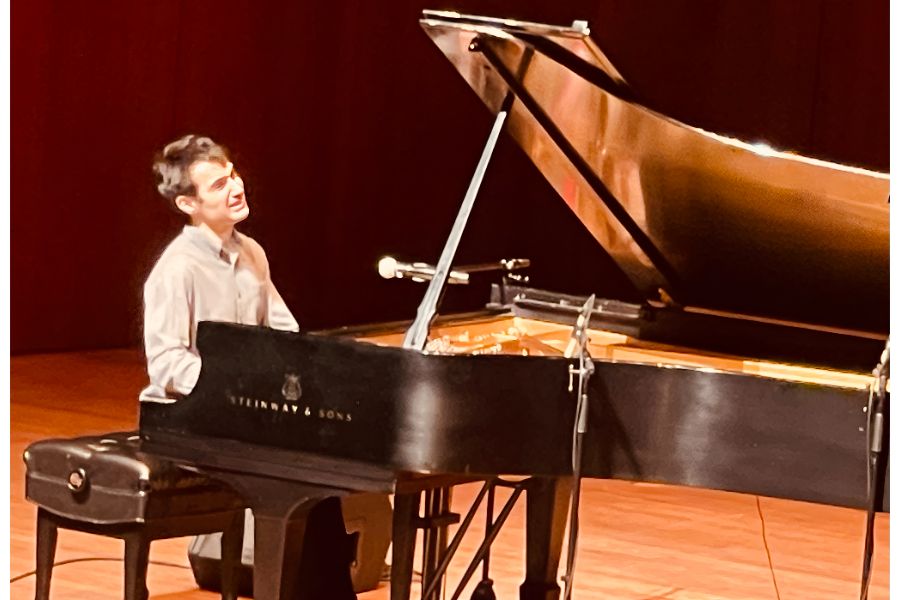
After intermission, the program shifted to Hamasyan’s solo performance. Taking the stage to vigorous applause, he sat at a concert grand Steinway and mesmerized us for about 45 minutes.

What I enjoyed most was what I will call his aghpuir moments—named for the Armenian word աղբյուր, meaning “spring.” In these passages, often two-thirds of the way through a piece, Hamasyan would shift to the highest register of the piano, leaning over the keyboard, his eyes nearly level with his fingers. There, he would improvise fragments of Armenian melodies in a bubbling, fluid style, reminiscent of a natural spring or babbling brook, hence the Armenian word aghpuir.
Following the performance, we met several Armenians, most of whom were from the Republic of Armenia. Some of them had driven two or three hours to be there and planned to return home that same evening. Although Hamasyan did not come to the afterglow, having performed in the same hall, I knew where the green room was. My wife, Judy, encouraged me to go and try to meet him. I was a little hesitant because I have heard that Hamasyan is a very shy person, but I did go and he was very gracious, taking a photo with me.
Tigran Hamasyan is an immense talent—a national treasure for Armenians and highly regarded by a large non-Armenian following around the world. If you are unfamiliar with his work, find him on YouTube and listen to his music. And if he performs in your city, I wholeheartedly encourage you to go. I am most definitely a fan.


No comments:
Post a Comment